
Why Technology Leadership Without BRM Is Becoming Too Expensive to Ignore
Most technology leaders are already paying the same three costs. Strategy and execution drift apart before a project is finished. Resources go into initiatives the business was never ready for. Expected revenue never fully materializes, even when the technology performs exactly as designed. These aren’t edge cases. They’re the default outcome when strategic BRM capability is missing from the operating model.
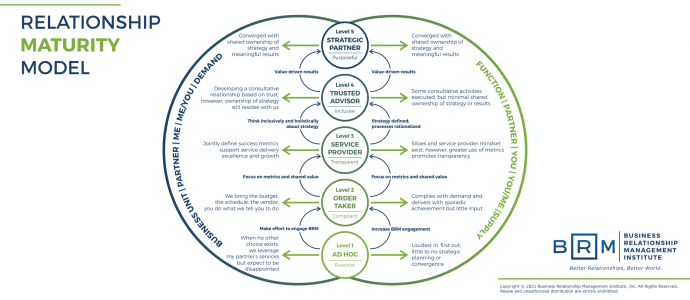
Business Relationship Manager (BRM) Metrics Example
It comes as no surprise; executives frequently ask for Business Relationship Management (BRM) metrics and the financial business value added to the business through the BRM Capability. BRM Institute has a mission to inspire, promote, and develop excellence in Business Relationship Management across the globe, leading to outstanding business value for organizations and professional fulfillment of every individual member of the BRM community.

Members, You’re First: The New Online Campus Launches Today!
Today marks a new era for BRM Institute. Starting August 26, 2026, Professional Members are getting exclusive first access to the new Online Campus — a beautiful, state-of-the-art platform built for the single, global BRM Community. Explore Remi, our new AI Agent, the interactive BRMiBOK, Career Central, Volunteer Central, BRM Communities, and much more, all before anyone else.

The Human Edge in AI: Why Every AI Team Needs a Business Relationship Manager
I’ve sat on AI teams and heard the same sentence over and over: “We really need someone like you to help us translate, showcase, and connect all the great things we’re doing with the rest of the business.” I’ve heard it again and again from the AI team I’m a part of, and I believe it’s the perfect example of what we as BRMs can bring to any team we join. I’ve taken the business relationships and the influence I already had through my work as a BRM and used them to further the work of that AI team. That person isn’t optional anymore. It’s the difference between AI that looks impressive in demos and AI that moves the numbers.

Stop Measuring Relationship Roles on Documentation. Start Measuring Them on Results.
Most performance systems for people who sit between strategy and delivery are broken. They track documents completed, plans updated, meetings held, and relationships “matured.” The result is a scorecard that rewards process theater while the business still wonders what actually got delivered. We need a different approach. The work of converting strategy and customer needs into measurable results is not a documentation job. It is a leadership discipline. Whether your organization calls these people Business Relationship Managers, strategic partners, value leads, or simply leaders who own the gap between intent and impact — the same progressive standards should apply.

2026 BRMConnect: Speakers, Sessions & Why You Should Attend
Every organization is racing toward AI right now. Fewer are asking the harder question: once the tools are in place, what still has to be human? BRMConnect 2026 is built around the answer — influence, trust, judgment, and the kind of relationship capital that no algorithm can replicate. Whether you’re new to the BRM discipline or leading it from the C-suite, this year’s sessions are designed to arm you with exactly that: the human superpowers AI can’t touch. Attendees move through five tracks, each built for a different stage of the journey — from Mastery & Legacy (building capabilities that outlive any one role or initiative) to Anticipatory Value Orchestration (leading human-AI convergence before it’s demanded of you). Wherever you are in your career, there’s a track built for the problems you’re actually solving right now.

The BRMiBOK in Practice: How Mayo Clinic Made the Case for BRM
The answers came back in the language of relationship. Nursing called their BRM a great navigator and a tremendous strength. Pharmacy praised the traffic control. The Department of Medicine said their BRD brings ideas they had not considered and has been instrumental in bridging business and IT conversations. The leader of Mayo Collaborative Services, home to a major reference lab and biopharma initiative, described the BRD as filling a crucial role in business planning itself.

Salt is Not on the Menu
And here’s the part that matters: smart leaders know it. The best CEOs and CIOs aren’t waiting for the fire report. They’re asking why the building never burned. They understand that the absence of disaster is not an accident — it’s a function. It’s a capability. It’s someone in the room who knew what was coming and moved early. That’s why organizations are reaching for BRM skills faster than ever. The demand is real, it’s growing, and it’s not slowing down. Leaders who have seen BRM work don’t unlearn it. They replicate it.
Find Your Perfect Pathway: Introducing the BRM Personalized Learning Advisor
Professional development should feel like an opportunity, not a puzzle. Yet for many Business Relationship Management professionals, the sheer range of training options available can make getting started — or knowing what comes next — genuinely overwhelming. Which course is right for where you are right now? What credentials should you pursue? How do you maintain what you’ve already earned? Where do you even begin? The BRM Institute has an answer: meet the BRM Personalized Learning Advisor.

Neither Here Nor There, and Somehow That’s the Job
The progress that BRM work enables is slow. Sometimes invisibly slow. And I mean really slowly, in a way I want you to feel rather than just read. The change in how two teams relate to each other doesn’t happen because of one conversation. It happens because of fifty small moments, most of which are indistinguishable from just doing your job. But here is the thing about that kind of work. It builds something more enduring than a deliverable.

Most Organizations Say They Want Innovation…
Most organizations say they want innovation. But if we’re honest… most organizations are still designed to reward predictability, certainty and efficiency. Oh, and fast execution! None of those things are bad. The problem begins when organizations try to solve uncertain, ambiguous, fast-changing challenges using the exact same mindset they use to operate the business. That tension is showing up everywhere right now. Leaders want transformation, but teams feel pressure to already have the answers. People are asked to think differently, but are rewarded for staying inside the process. Innovation becomes something organizations talk about… while unintentionally creating cultures that make experimentation feel unsafe. And if you’re a BRM, you probably feel this tension because you sit in the middle of competing realities

Everybody’s Doing Their Job. Nothing is Getting Done.
BRM is not a new concept. Humans have always known that relationships are the foundation of how things get done. What is new is the intentionality around it. The recognition that trust does not just happen because people share a Slack workspace or attend the same all-hands. It has to be built, nurtured, and treated as a real organizational priority.

The Five BRM Strengths: A Foundation for Evolving Culture, Building Partnerships, and Driving Value
The BRM Institute’s five strengths — Empathy, Trust, Creativity, Collaborative, and Leadership — are the human qualities that make that mission possible. Each strength corresponds directly to a capability or competency cluster within the BRMBOK, and together they form the behavioral foundation that moves a BRM from order-taker to strategic partner.

From Data to Decisions: Storytelling, BRM and Turning Information into Action
There’s no shortage of data in today’s organizations. In fact, most teams are drowning in it—dashboards, reports, metrics, KPIs—all neatly packaged and readily available. And yet, despite all of this, a familiar question keeps surfacing in leadership conversations: What does this actually mean for us? The challenge isn’t access to data. It’s making sense of it in a way that drives action. The real shift doesn’t happen when data is visualized. It happens when it’s explained—when someone connects the dots between the data and the business, between what’s happening and why it matters. That narrative is what drives action.
Stop Guessing Your Value: Use These 6 SMART Goals to Make Your Relationship Impact Measurable and Visible
Here’s a truth many professionals know but rarely say out loud: being valued and being measured are two very different things. You build the relationships. You translate strategy into action. You sit in the room where decisions happen and ensure the right voices are heard. You are, in every practical sense, the connective tissue that holds your organization together. And then comes performance review season.
Suddenly, the work that is most uniquely yours, the trust you’ve built, the alignment you’ve brokered, the opportunities you’ve surfaced before anyone else even knew to look, and the value and impact you’ve ensured happened, struggles to fit neatly into a box on a form. That’s not a you problem. That’s a goal-setting problem. And it’s one we can fix.
BRMs Have Quietly Become the Most Powerful Role in the Enterprise
Organizations don’t always announce when a role becomes indispensable. The shift happens quietly—until suddenly, nothing meaningful moves forward without it. That’s exactly what’s happening with Business Relationship Management. Across industries, the most successful organizations aren’t just running projects—they’re building connected ecosystems of strategy, technology, people, and value. And at the center of that shift? The Business Relationship Manager. This isn’t about influence for influence’s sake. It’s about shaping direction, accelerating decisions, and ensuring investments translate into real results. And increasingly, organizations are realizing that BRMs aren’t expendable roles—they’re essential strategic engines.

Why BRMConnect is the Learning Event that Professionals Can’t Miss
Every year, professionals search for that one event—the experience that changes how they think, how they lead, and how they deliver value within their organizations. BRMConnect is that event. If you’re serious about evolving your BRM practice and strengthening your impact inside your organization, here’s why BRMConnect should be on your calendar. Over 94% of attendees say it was the best learning event of their career. 96% say they were able to immediately apply what they learned in their own practice. 93% say they would recommend bringing their CXO or Executive Leadership to the event. Many conferences leave attendees inspired—but unsure how to apply what they’ve learned. BRMConnect is different. Every session is designed to give participants practical frameworks, tools, and approaches that can be applied the moment they return to work. That’s why nearly every attendee reports putting new ideas into practice immediately.
The CIO’s Practical Guide to Advancing BRM
For years, CIOs have optimized for delivery excellence — uptime, cost control, project execution, cybersecurity resilience. Those capabilities are critical. But they are table stakes. They do not, by themselves, reposition technology as a driver of growth. What changes the narrative is convergence.