Bridging Science and Connection: A Doctoral Journey into Relationship Maturity and Global Team Dynamics
This research began with curiosity and with people. After years of leading teams across multiple continents, I found myself returning to the same question: Why do some global teams build trust and deliver lasting impact, while others fracture under distance and complexity?
I had seen it time and again, teams with equal access to talent, technology, and vision, yet vastly different and inconsistent outcomes. Some operated with cohesion and clarity, almost effortlessly translating collaboration into innovation. Others struggled under the weight of miscommunication and mistrust, their potential lost in translation, sometimes literally. The difference, I discovered, lay not in systems or structure, but in the maturity of the relationships that held those teams together.
That question, how relational dynamics shape performance across distance, became the foundation of my Doctorate, completed through Eaton Business School and Guglielmo Marconi University, where I examined the impact of relationship maturity on business outcomes in globally dispersed teams.
This doctoral journey did not emerge in isolation. It was born from the momentum of my Master’s research, in which I achieved the highest honours for exploring leadership and collaboration within complex organizations. Yet, even as I celebrated that milestone, I felt the topic calling for deeper exploration.
My master’s study had revealed powerful links between interpersonal trust, leadership empathy, and performance, but I sensed a missing dimension. Understanding not only how these dynamics unfolded within a single context, but why they shifted when stretched across the cultural and geographical boundaries that define modern organizations created intense curiosity.
Download the Full Research Report
Why I Chose This Topic
Over the course of my career, and having worked across Asia, Africa, Europe, the Middle East, Australia, and North America, these experiences offered a rare vantage point: a global laboratory for observing how people connect, communicate, and create value across cultures.
Across borders and time zones, one could witness how distance magnifies the human element. A five – minute conversation in one country could take weeks of clarification in another. The same message could inspire in one culture and alienate in another. In those moments, a realization; that technical excellence alone is not enough, it is the relational and cultural fluency of teams that determines whether collaboration thrives or fails.
This realization deepened the fascination with cultural intelligence (CQ), the capability to understand, respect, and adapt to cultural differences in ways that build trust and enable collaboration. Cultural intelligence became the bridge between relationship maturity and performance in my research. It illuminated why some teams could build empathy across oceans while others stumbled over misunderstanding or unconscious bias.
High-performing global teams, per the study, shared a common trait: they approached difference with curiosity, not judgment. They demonstrated awareness, humility, and adaptability, hallmarks of high cultural intelligence. This competency amplified relationship maturity by fostering respect and psychological safety, creating an environment where diverse perspectives could be expressed and integrated rather than suppressed.
Conversely, where cultural awareness was absent, even technically competent teams struggled. Misinterpretations grew into conflict, and trust eroded under assumptions. The data later confirmed what experience had demonstrated, is that relationship maturity cannot be fully developed without cultural intelligence. The two are interdependent: one nurtures the emotional architecture of connection, while the other governs how effectively that connection can span diversity.
It was this intersection, between relational depth and cultural agility, that compelled me to pursue this research in greater depth. Moving beyond anecdotal insight to empirical evidence, to translate lived experience into a framework that organizations could measure, develop, and sustain. The goal was to demonstrate that relational and cultural intelligence are not abstract ideals, that they are strategic assets that determine how successfully global organizations deliver value, innovate, and endure.
How the Research Developed
Designing this research required a framework capable of capturing both the science and soul of human connection in organizations. Spanning Asia, Africa, Europe, the Middle East, Australia, and North America, the study had revealed that while the context of work changes dramatically across regions, the challenges of collaboration remain universal. Yet, the expressions of trust, respect, and communication differ profoundly depending on cultural norms, power distance, and communication styles.
To explore this intersection of relationship maturity and cultural intelligence, I adopted a mixed methods design, combining the statistical precision of quantitative analysis with the interpretive depth of qualitative inquiry. This approach reflected my belief that understanding human systems requires both data and dialogue, numbers to validate patterns, and voices to explain them.
The quantitative phase involved a global survey distributed to participants across multiple industries and geographies, examining key dimensions of relationship maturity, including trust, transparency, empathy, shared purpose, and accountability. These variables were correlated against business outcome indicators such as innovation, stakeholder satisfaction, collaboration effectiveness, and delivery performance. Using advanced statistical analysis, data was assessed and insights extracted, testing whether higher levels of relationship maturity predicted stronger business outcomes, and whether these relationships held consistent across cultural contexts.
The qualitative phase provided the heartbeat of the research. Through a series of in-depth interviews and thematic analysis, it sought to understand how individuals and teams experienced relationship maturity across different environments. Participants shared stories of alignment and misunderstanding, resilience and breakdown, moments where distance fostered innovation, and in contrast, where it created silence. These narratives provided texture and meaning to the quantitative results, revealing that culture is not merely a backdrop but an active force that shapes how relationships are formed and sustained.
What made this research distinct was its global lens. Respondents represented multiple continents, time zones, and business functions, from operational teams in Asia to leadership groups in North America, innovation hubs in Europe, and transformation programs in Africa and the Middle East. This diversity enabled a nuanced comparison of how relationship maturity manifested across regions with different leadership styles, communication preferences, and decision-making hierarchies.
Throughout the analysis, cultural intelligence emerged as both a mediator and a multiplier. Teams with high relational maturity but low cultural awareness often plateaued in performance; those that coupled both capabilities demonstrated exponential gains. This finding underscored that relational excellence is not a fixed state but a learned competency, but one that evolves through exposure, reflection, and deliberate practice.
Key Findings
The research revealed that relationship maturity is a measurable capability with a direct influence on business outcomes. Teams demonstrating high relationship maturity consistently achieved stronger results in value realization, innovation, and stakeholder satisfaction, across industries and geographies.
Relationship Maturity as a Performance Multiplier
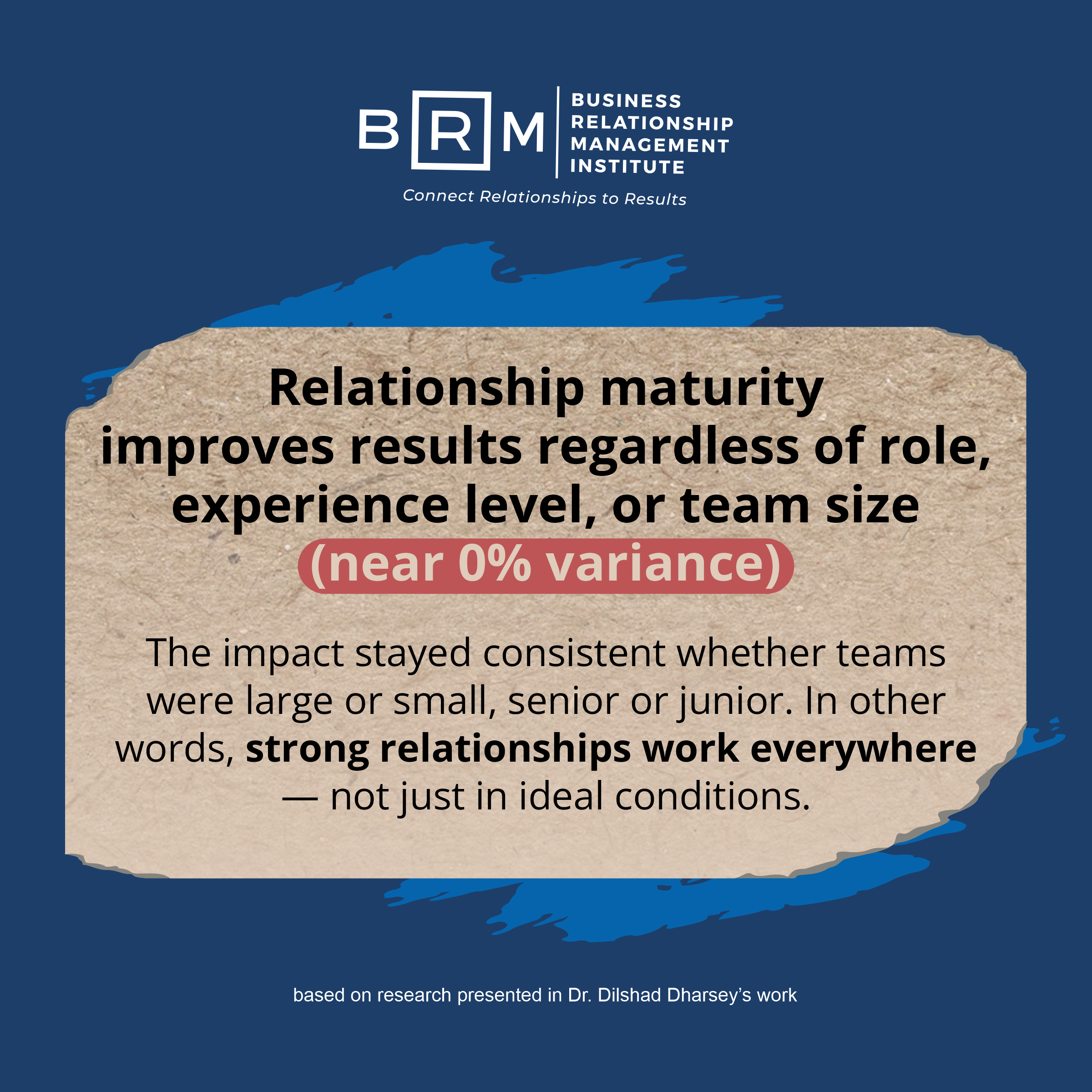
Quantitative analysis confirmed a strong, positive correlation between relationship maturity and business outcomes. Teams that scored highest on trust, communication, and shared purpose outperformed others across nearly every measure of success; from project delivery and innovation to engagement and cross-functional alignment.
Cultural Intelligence as the Amplifier
Cultural intelligence (CQ) emerged as a defining enabler of relational maturity. Teams that coupled relational and cultural intelligence achieved exponential results. Cultural awareness created empathy, transforming difference from a barrier into a catalyst for creativity. Relationship maturity without cultural intelligence was incomplete, providing structure but lacking adaptability.
The Human Dimensions of Trust and Empathy
Qualitative interviews brought depth to the findings. Participants described the experience of “feeling seen,” “being heard,” and “knowing someone has your back” as pivotal to team success. Trust and empathy emerged as strategic levers that underpin innovation and problem-solving.
Leadership and Psychological Safety
High-maturity teams were consistently led by individuals who modelled transparency, humility, and inclusivity. These leaders fostered psychological safety, the confidence to speak up, disagree, or make mistakes without fear of repercussion , which in turn fuelled collaboration and innovation.
A Model for Global Collaboration
The study produced a model linking relationship maturity, cultural intelligence, and business outcomes. Relationship maturity provides the infrastructure for connection; cultural intelligence ensures that connection can travel across difference. Together, they enable transformative collaboration and co-created value.
The Broader Implication
Ultimately, the research reaffirmed a simple truth: business success is human success. Technology accelerates communication, but only relational and cultural intelligence sustain it.

Implications for BRMs and Global Leaders
The findings hold profound implications for how organizations and Business Relationship Managers (BRMs) approach collaboration and value realization in a globalized world. Relationship maturity and cultural intelligence are operational capabilities, not soft skills , that define whether teams achieve transactional efficiency or transformative impact.
1. Redefining the Role of the BRM
BRMs are architects of trust and translators of context. Their greatest value lies in relational fluency, aligning diverse stakeholders through empathy, credibility, and influence.
2. Building Culturally Intelligent Organizations
Developing cultural intelligence involves adaptive capability, it is the ability to flex leadership and communication styles according to context. Organizations that embed CQ experience higher engagement, faster decision-making, and stronger innovation.
3. From Transactional Delivery to Transformative Partnership
High-maturity relationships move organizations from managing demand to enabling collaboration. BRMs act as integrators of people, process, and purpose, facilitating dialogue that transforms tactical conversations into strategic co-creation.
4. Leadership as a Relational Practice
Leadership becomes a relational practice, defined by transparency, humility, and presence. Empathic leaders listen without bias, build bridges where silos exist, and influence through connection.
5. Operationalizing Relationship Maturity
Organizations can apply practical steps: relationship maturity assessments, CQ development programs, leadership coaching, and cross-cultural mentorship. When embedded into strategy, relational maturity becomes a competitive differentiator.
6. The Future of Business Relationship Management
The next frontier of BRM maturity will be defined not by process efficiency, but by the quality of human relationships that sustain innovation, resilience, and shared value creation.
Personal Reflection and Conclusion
Completing this Doctorate was both an intellectual and emotional journey, one that reshaped how I view leadership, connection, and impact. Balancing research with global responsibilities and personal challenges taught me the discipline of reflection and the power of authenticity.
The process transformed my understanding of success. I learned that leadership is not defined by authority, but by the capacity to create trust in uncertain spaces, to connect people to purpose, and purpose to performance. This research reaffirmed that relationships are not the “soft side” of business; they are its strategic foundation.
As organizations evolve toward more distributed, digital, and diverse ecosystems, our ability to cultivate relational and cultural intelligence will define the next generation of leadership. Business outcomes will increasingly depend not only on what we know or build, but on how deeply we understand one another.
For me, this journey was never about a degree. It was about a conviction: that human connection, when nurtured with empathy and respect, remains the most enduring form of innovation. In every sense, it is the bridge between science and connection, and the essence of Business Relationship Management.


About the Author
Dr. Dilchad Dharsey
Dr. Dilchad Dharsey is a Global IT Director and Strategic Business Relationship Management (BRM) leader, specializing in enterprise-wide digital transformation that bridges technology and business value. With over 20 years of experience spanning engineering, luxury retail, nuclear, FMCG, and financial sectors, Dilchad has successfully led multi-million-dollar programs, including SAP S/4 ERP rollouts and legacy modernization initiatives across APAC and EMEA.
At Xylem, he recently enhanced system turnaround by 40% and cleared 82% of the operational backlog in APAC, while also spearheading a global ERP deployment. A certified CBRM and double MBA holder, Dilchad is completing a Doctorate focused on the relationship maturity of globally dispersed teams—a subject he shares as a keynote speaker and academic lecturer worldwide.
Dilchad thrives at the intersection of people, process, and technology, empowering organizations through governance, strategic IT roadmapping, project oversight, continuous improvement, and stakeholder alignment. He is deeply committed to inclusive leadership, sustainability, and mentoring the next generation of professionals through teaching and CSR initiatives.