Leading Through Connection: Why the Future Belongs to Advanced Relationship Leaders
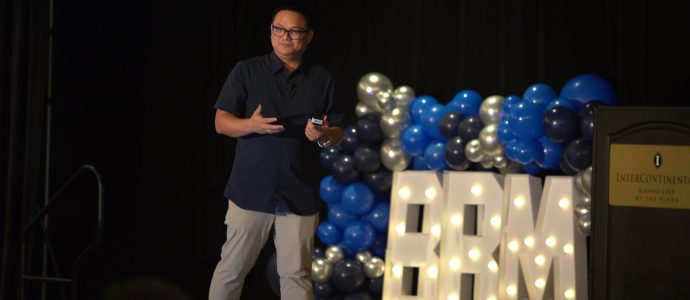
As artificial intelligence accelerates change and organizations transform at unprecedented speed, the true differentiator for leaders will no longer be how fast they move—but how deeply they connect. In his keynote, “The Path to Becoming an Advanced Relationship Leader,” Glenn Remoreras makes a compelling case that in a world reshaped by automation, remote work, and hybrid collaboration, the greatest advantage we have left is profoundly human: the ability to build trust and lead through authentic relationships.
Change today is relentless. Business models decentralize, teams disperse, technology advances faster than culture can catch up. Amid this chaos, Remoreras invites us to reimagine leadership not as control, but as connection. He challenges the old view that relationships are soft skills or side projects. Instead, he describes them as the engine of transformation—the unseen infrastructure that allows organizations to thrive amid uncertainty. His message is clear: the future of leadership belongs to those who can align, inspire, and innovate through the power of human relationships.
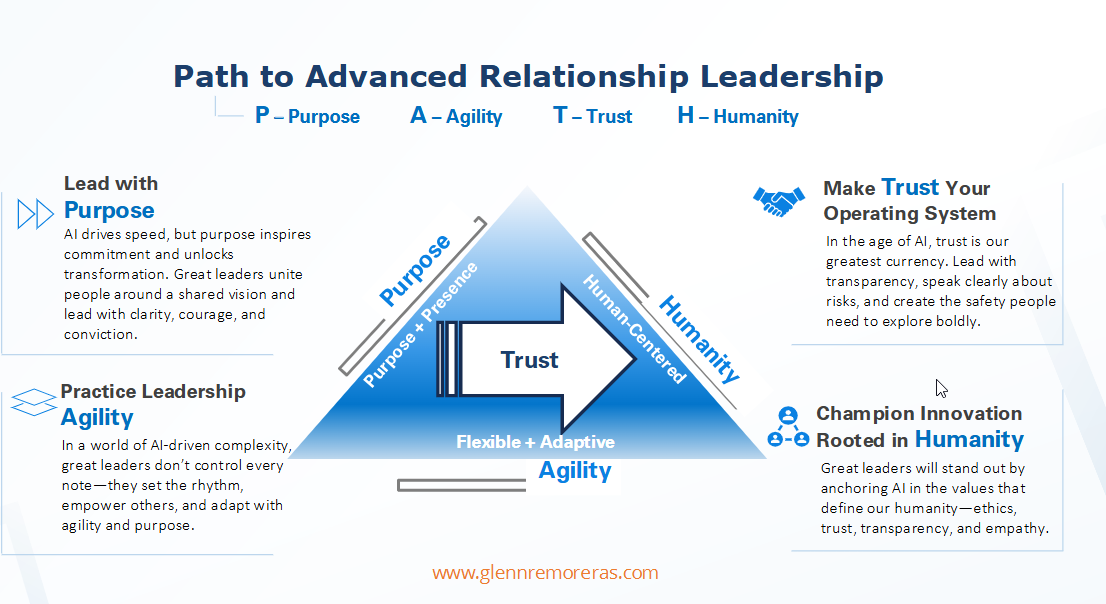
At the center of his thinking is a simple but powerful framework: PATH. The model stands for Purpose, Agility, Trust, and Humanity—four interdependent pillars that define the mindset of an advanced relationship leader. Each one demands attention not as a separate trait, but as part of an integrated way of being.
Purpose, Remoreras explains, is not a slogan—it’s lived. It’s the anchor that gives direction meaning when everything else is in motion. People don’t commit to processes; they commit to purpose. When leaders are clear about their “why,” others find strength and alignment in the face of change. Agility then becomes the expression of that purpose in motion. It’s not simply reacting quickly, but leading with adaptability, reading the rhythm of change, and shifting course before disruption dictates the terms.
Trust is the heartbeat of the entire system.
For Remoreras, it isn’t a virtue—it’s an operating system. When trust runs high, teams can take risks, recover from failure, and move forward with speed and confidence. When it’s absent, even the simplest decisions stall. Trust multiplies the effectiveness of everything else leaders do. And finally, Humanity—the reminder that innovation and technology must serve people, not the other way around. It’s what grounds ethical decisions, empathy, and fairness in everyday leadership practice.
Throughout his keynote, Remoreras breathes life into the framework with stories—real, human stories of tension, missteps, and growth. He shows how transformation rarely comes from adding more process or power, but from slowing down to listen, question assumptions, and reconnect. In moments of inflection, the most effective leaders are those who know how to restore alignment through relationship, not authority. These stories turn PATH from an acronym into a lived experience—something leaders can practice, refine, and grow into over time.
This approach resonates deeply with the discipline of Business Relationship Management. BRMs already operate in the space where relationships drive value. The same principles that define advanced relationship leadership—purpose, agility, trust, and humanity—are the cornerstones of BRM practice. BRMs are the ones aligning purpose and value across business and technology, building bridges between silos, and ensuring innovation stays human-centered. In many ways, BRMs embody the PATH model in motion, bringing relational leadership into the everyday reality of organizational life.
Remoreras doesn’t leave the conversation in theory. He offers a series of practical levers for anyone ready to walk the path. Start with intentional reflection—ask why you lead, what you believe in, and how that belief shows up in your actions.
Experiment with adaptive structures that allow flexibility and shared ownership. When trust breaks, repair it openly and vulnerably. Embed human metrics—measure connection, collaboration, and psychological safety alongside productivity. And remember that leadership often happens in small, quiet moments—clarity in a meeting, empathy in a tough conversation, presence in a moment of doubt. These are the moments that build trust and shape culture more than any strategic directive ever could.
Ultimately, Remoreras’ message is one of evolution. As machines grow more capable, the kind of leadership that matters most will be the kind that cannot be automated—the leadership that connects, inspires, and sustains. The path to becoming an advanced relationship leader is not linear or easy. It requires courage to pause, humility to listen, and consistency to realign. But the reward is lasting: organizations where change is not feared, but co-owned; where people feel seen, valued, and trusted; where purpose is not a statement, but a shared way of working.