The Great Convergence: Where Tech, Business & Humanity Meet

This article explores the convergence of technology, business, government, and people and its impact on modern governance. It positions the Business Relationship Manager (BRM) as a critical link between innovation and democratic accountability. Drawing on Public Value Theory and digital governance research, the article argues that BRMs act as relational architects—integrating technical capability with ethical stewardship.
Through strategic partnering, value management, and governance foresight, BRMs shift modernization from a technical initiative to a civic endeavor. Using practical frameworks and real-world use cases, the article demonstrates that successful digital transformation depends less on technology and more on the human capacity to manage relationships across converging systems. This article was written by Dr. Shellie Bowman.
Introduction:
The boundaries among technology, business, government, and the people are increasingly blurred, creating a new governance reality in which digital systems shape institutions, business decisions influence public outcomes, and citizens experience the effects of both. This convergence is redefining how public value is created, resources are allocated, and trust is maintained. Within this landscape, the Business Relationship Manager (BRM) has emerged as a role of growing strategic and civic importance. In the public sector, BRMs operate at the intersection of institutional performance and public accountability, shaping how technology-driven initiatives are interpreted, implemented, and justified in the public interest.
Within this article, Dr. Shellie M. Bowman, Sr. MBRM, CIPP/US, ACC examines how public-sector BRMs apply interdisciplinary competencies—combining strategic partnering, value management, governance, and ethics—to align citizen wellbeing, organizational objectives, and business practices through the effective use of technology. This perspective extends beyond efficiency to emphasize public value creation. It positions BRMs as relational architects who transform convergence from a technical challenge into a disciplined practice of democratic trust, equitable service, and sustainable outcomes.
Please continue reading to access the abbreviated version of this article, or we encourage you to download the full length article and attend the webinar on Managing the Convergence of Technology, Business, Government and People with Dr. Shellie Bowman, happening on January 14, 2026 from 11:00 AM- 12:00 PM EST.
Download the PDF version of the full length article by clicking the image on the right.
Theoretical Foundation: The Four-Point Convergence
The convergence of technology, business, government, and the people reflects a fundamental shift in how public value is created. Once distinct, these forces now interact continuously: technology enables capability, business shapes strategy, government provides legitimacy, and the people confer trust through lived experience.
Within this dynamic, the Business Relationship Manager (BRM) serves as the integrator, aligning these domains through ethical judgment, technical insight, and governance expertise.
Public Value Theory
Public Value Theory (Moore, 1995) defines government success by outcomes the public values as legitimate, equitable, and effective. Public value governance (Bryson, Crosby, & Bloomberg, 2017) extends this view to cross-sector collaboration. In this framework, BRMs act as strategic orchestrators, translating policy intent into trusted outcomes and embedding technology and management practices within a civic, rather than purely operational, context.
The BRM Competency Model (2025): Public-Sector Application
The Business Relationship Management Institute (BRM Institute, 2025) defines BRM practice as inherently people-dominant, with success driven by mindset, human capability, and continuous learning rather than standardized processes. In the public sector, this elevates the BRM from liaison to public value leader operating across civic, technological, and organizational boundaries. The 2025 BRM Competency Model—Evolve Culture, Build Partnerships, Drive Value, and Satisfy Purpose—provides a practical framework for this role.
- Evolve Culture shapes institutional narratives that support transparency, accountability, and innovation, positioning digital initiatives as service improvements rather than administrative change.
- Build Partnerships emphasizes cross-sector collaboration, enabling BRMs to strengthen relationship capital across agencies, vendors, civic organizations, and communities.
- Drive Value applies the BRM Value Framework within public accountability constraints, integrating financial stewardship with service quality, social equity, sustainability, and public benefit.
- Satisfy Purpose anchors leadership in moral purpose and long-term stewardship, ensuring technology serves human needs and advances the common good.
Together, these four competencies enable BRMs to embody and manage convergence. They operationalize public value and digital governance theories into measurable leadership behavior. Through relational mastery, analytical rigor, and ethical stewardship, BRMs transform complex digital initiatives into outcomes that strengthen governance and elevate public trust.
Applied Use Cases: Illustrating the BRM's Role in Public-Sector Convergence
The following use cases are illustrative rather than exhaustive. They demonstrate how Business Relationship Managers (BRMs) operationalize the convergence of technology, business, government, and the people through relational governance and ethical foresight. Grounded in Public Value Theory (Moore, 1995) and Public Value Governance (Bryson, Crosby, & Bloomberg, 2017), they demonstrate that modernization succeeds only when technical performance and democratic legitimacy advance together. In each case, the BRM serves as the intermediary linking digital innovation to civic trust.
Data Center Modernization and Community Impact
Data center modernization highlights the intersection of digital infrastructure, policy, sustainability, and public perception. Digital-era governance research shows that technology and organizational reform are inseparable (Dunleavy et al., 2006). When modernization is driven solely by procurement or efficiency, community engagement is minimized, often resulting in resistance and reduced legitimacy.
A BRM-led approach reframes modernization as a public investment. By convening technical teams, regulators, and community stakeholders, the BRM aligns operational capability with public purpose and authorizing legitimacy, reflecting Moore’s strategic triangle and collaborative value governance. The outcome is modernization that delivers cost efficiency, environmental gains, and visible community benefit—achieving results that are both effective and publicly defensible.
Artificial Intelligence in Public Services
Artificial intelligence (AI) is transforming service delivery, yet it poses profound ethical and administrative risks. Bannister and Connolly (2014) argue that digital tools alter not only efficiency but also the nature of democratic accountability. Without a BRM, AI adoption often privileges automation speed over fairness, producing opacity and bias that undermine trust.
Under BRM leadership, implementation follows the governance-by-design principles outlined by Meijer and Bannister (2016). The BRM coordinates collaboration among technologists, policymakers, and ethics officers to create pre-deployment review processes, transparency standards, and public communication strategies. This ensures that automation strengthens rather than subverts procedural justice. The measurable value includes efficiency, reliability, and the reinforcement of legitimacy through transparent oversight.
Cloud Migration and Interagency Collaboration
Cloud migration offers scale and flexibility but, absent relational governance, can reproduce fragmentation across agencies. Dunleavy et al. (2006) observe that the digital state must integrate information architectures to sustain accountability. When agencies migrate independently, inconsistent data policies and duplicated contracts erode both efficiency and coherence.
A BRM transforms migration from a procurement exercise into a convergence initiative. By applying Bryson et al.’s (2017) framework of networked collaboration, the BRM harmonizes governance policies, security protocols, and procurement cycles. Value measurement extends beyond cost savings to include interoperability, policy agility, and analytic capability, public-sector analogs to Moore’s (1995) authorizing and operational dimensions of value. The outcome is a federated yet coordinated infrastructure that enables cross-agency insight and transparency.
Automation and Workforce Transformation
Automation promises efficiency but can alienate employees and communities if framed solely as cost reduction. Argyris and Schön (1996) remind leaders that organizational learning requires reflection on governing assumptions, not just improved tactics. A BRM facilitates this reflective capacity by convening staff, unions, and managers to co-design automation that augments human expertise rather than replaces it.
Through participatory workshops, the BRM links Moore’s (1995) concept of value legitimacy to workforce well-being, embedding training and reskilling into implementation. The result is not only higher throughput but also increased morale and adaptive capacity. In the language of BRMI (2025), relational competencies become institutional infrastructure that sustain both performance and trust.
Digital Inclusion and Equity Initiatives
Expanding broadband access and digital literacy programs illustrates how technological initiatives shape equity outcomes. Bryson et al. (2017) contend that collaborative governance must produce benefits that are both instrumental and moral. When inclusion projects measure success by infrastructure alone, they replicate digital divides.
A BRM-directed initiative reconceives inclusion as a multidimensional value problem. The BRM partners with community organizations, educators, and private providers to align infrastructure with affordability, literacy, and data-privacy assurances.
Consistent with Meijer and Bannister (2016), transparency and accountability are built into program metrics, which capture participation and trust alongside connectivity. The initiative demonstrates that equity and efficiency can coexist, advancing Bannister and Connolly’s (2014) proposition that democratic legitimacy depends on meaningful access to information.
Across all scenarios, the same pattern holds. When modernization proceeds without a BRM, technological rationality dominates and legitimacy deteriorates. When guided by a BRM, convergence produces value that is both operational and ethical. Each case operationalizes Moore’s (1995) theory of public value and Bryson et al.’s (2017) model of collaborative governance: the BRM mediates between technical systems and human systems, aligning innovation with institutional purpose. In this way, the BRM converts digital transformation from a coordination exercise into an enduring practice of democratic stewardship.
Implications for BRM Practice and Leadership
The convergence of technology, business, government, and society demands a new approach to public-sector leadership. Business Relationship Managers (BRMs) play a pivotal role in shaping disciplined governance from this convergence, translating theory into practice and aligning operational effectiveness with public trust (Moore, 1995; Dunleavy et al., 2006; BRM, 2025).
BRMs as Public-Value Leaders
Leadership legitimacy depends on outcomes citizens perceive as useful, fair, and transparent. BRMs embody Moore’s strategic triangle—public purpose, authorizing environment, and operational capability—through workshops, stakeholder mapping, and benefit realization. They mediate between policy and execution, ensuring technology initiatives advance democratic goals rather than institutional self-interest.
Relationship Management as Governance
Modern governance is relational. BRMs formalize collaboration by defining shared value, embedding it in service charters, and converting coordination into institutional accountability. Relational governance complements hierarchy and policy, fostering a participatory yet disciplined leadership that strengthens compliance, creativity, and legitimacy.
Competency Development as Institutional Infrastructure
BRM competencies—strategic partnering, value management, portfolio alignment, and business acumen—are organizational assets. Public agencies can embed these into curricula, performance evaluations, and mentoring networks, transforming individual capability into institutional resilience. Competency becomes a mechanism for ethical consistency, continuous improvement, and sustainable leadership.
Redefining Value Measurement
Traditional metrics emphasize efficiency, but public value is multidimensional. BRMs design integrated frameworks combining quantitative and qualitative indicators, linking financial performance to accessibility, fairness, satisfaction, and trust. This approach operationalizes Moore’s principle that value must be socially validated, making technology investments accountable to citizens’ lived experiences.
Ethical Stewardship and Accountability
In data-intensive environments, BRMs act as ethical stewards, embedding privacy, bias mitigation, and transparency into digital systems (Meijer & Bannister, 2016). Ethical competence elevates BRMs from operational oversight to moral guardianship, enhancing public confidence and safeguarding institutional legitimacy.
Leadership Readiness and Organizational Maturity
Institutional readiness requires both culture and infrastructure. Agencies should integrate BRMs as central actors through executive councils, convergence charters, and value-realization offices. BRMs facilitate double-loop learning (Argyris & Schön, 1996), helping organizations question assumptions and cultivate enduring relational accountability.
Scholarly and Practical Contributions
By integrating Public Value Theory, Digital Governance, and BRM practice, this framework demonstrates that relationship management is a form of governance. BRMs transform technical capability into civic advancement, reframing modernization as a moral enterprise. Success in digital transformation depends less on technology than on the relational competencies that guide it. BRMs thus serve as both strategists and stewards, driving outcomes that are efficient, equitable, and enduring.
A Call for Leadership in the Age of Convergence
The convergence of technology, business, government, and the people is reshaping modern governance. Within this landscape, the Business Relationship Manager (BRM) emerges as a relational architect, uniting technical innovation with civic responsibility. This study demonstrates that BRMs are both operationally essential and morally central, ensuring that digital transformation remains accountable to the public.
The analysis highlights three interdependent insights. Theoretically, Public Value Theory (Moore, 1995) and digital governance research show that legitimacy and efficiency must be co-produced; BRMs translate technological potential into democratic performance. Practically, BRMs operationalize relational governance, converting networks, shared value definitions, and continuous learning into systems of accountability that outlast policy cycles. Ethically, BRMs embed foresight into digital design, mitigating bias, protecting privacy, and ensuring innovations serve citizens rather than simply advancing technology.
BRMs shift leadership from transactional management to relational stewardship. Competencies are institutionalized as governance infrastructure, integrating collaboration, transparency, and accountability into organizational culture. By aligning purpose and performance, BRMs reconcile data and dignity, structure and empathy, innovation and trust—transforming modernization into a human-centered, morally grounded enterprise.
This work advances scholarship by extending Public Value Theory and Digital-Era Governance to show that legitimacy is produced through human capability and relational practice. It situates BRMI’s competency model within a civic context, linking organizational and public value. For practitioners, it offers a roadmap to embed relational accountability in institutions; for scholars, it opens inquiry into how human capability mediates between digital power and democratic trust.
The challenge for leaders is to govern amid technological acceleration without losing moral direction. BRMs translate complexity into coherence and innovation into integrity. They bridge technical capability with ethical stewardship, positioning modernization as humane, inclusive, and accountable. Public institutions succeed not through algorithms alone but through consistent, competent, and compassionate relationships.
Ultimately, BRMs represent the living architecture of public trust. In the long arc of digital transformation, they distinguish between organizations that merely automate and those that renew governance, ensuring that public value is both created and sustained.
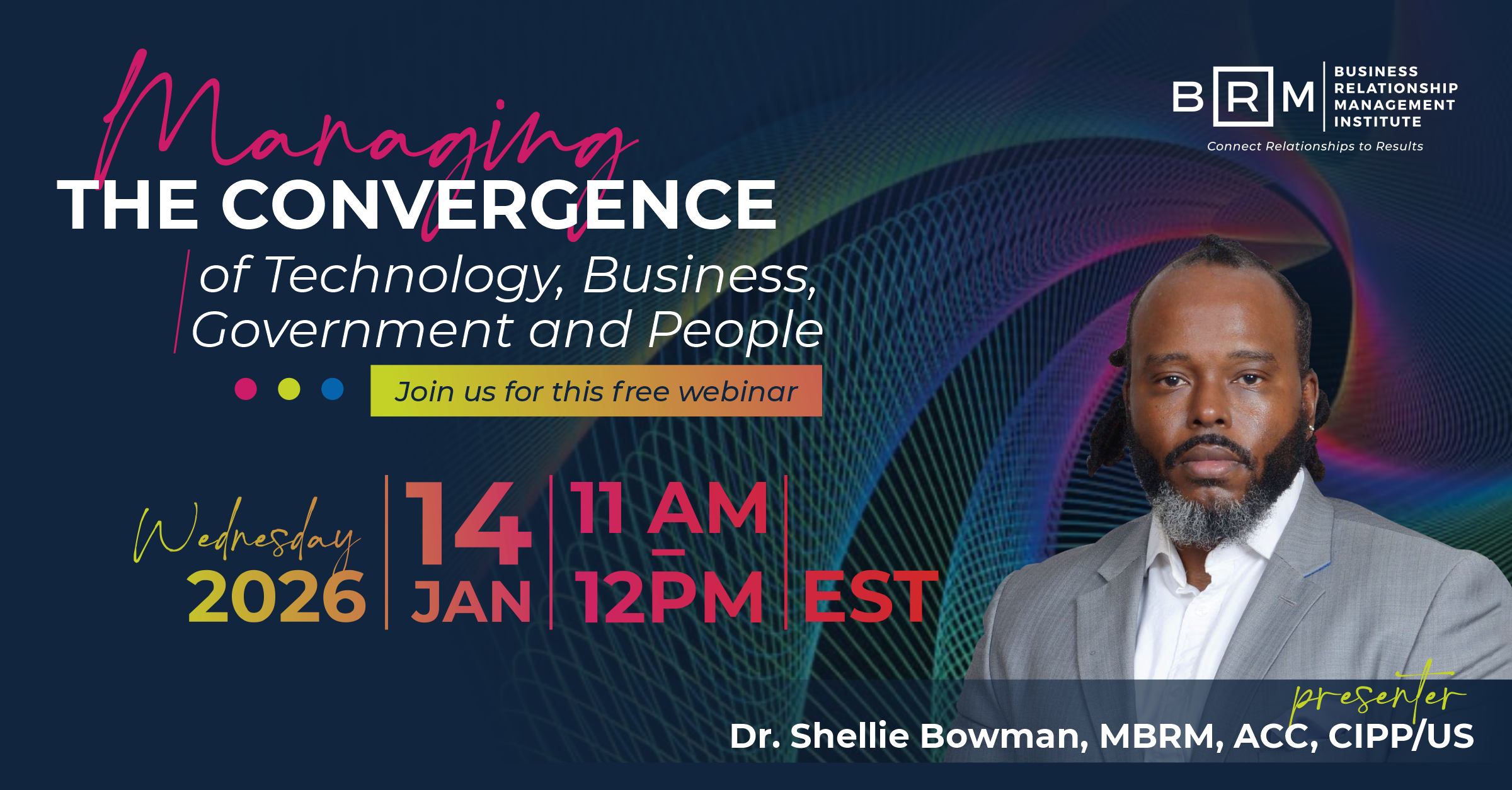
If you’d like to join this discussion live, please join us on January 14th, 2026 with Dr. Shellie Bowman to explore this topic in depth during a free webinar!