From Data to Decisions: Storytelling, BRM and Turning Information into Action

There’s no shortage of data in today’s organizations. In fact, most teams are drowning in it—dashboards, reports, metrics, KPIs—all neatly packaged and readily available. And yet, despite all of this, a familiar question keeps surfacing in leadership conversations:
What does this actually mean for us?
The challenge isn’t access to data. It’s making sense of it in a way that drives action.
While 94% of data and analytics leaders expect their function to play an important or pivotal role in organizational success, 29% still feel that data is undervalued or underutilized despite its importance. Gartner That tension—between having data and actually using it—defines one of the most persistent challenges in modern organizations.
As Info-Tech Research Group puts it, data is only the most basic foundation of knowledge. Analyzing it produces information. Studying that information leads to knowledge. And when you can gather and systemize that knowledge to effectively prepare for the future, you’ve developed wisdom. Info-Tech Research Group Most organizations are stuck somewhere between information and knowledge—and the gap is costly.
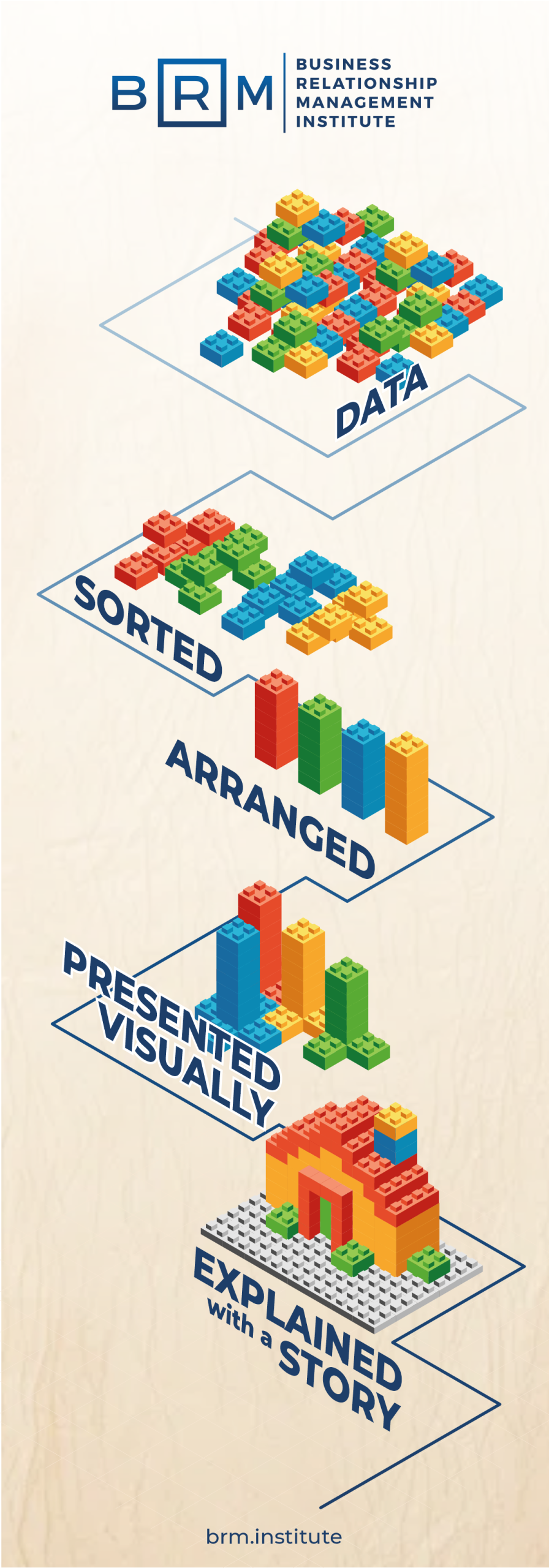
If you think about it, data starts out as something pretty unremarkable. It’s raw, unshaped, and often disconnected—just a collection of points waiting to be interpreted. Organizations invest heavily in capturing and storing it, but on its own, data doesn’t do much. It doesn’t tell a story. It doesn’t guide decisions. It just sits there, waiting.
So we try to bring order to it. We sort it, categorize it, organize it into something that feels more manageable. At that point, it starts to look useful. You can see what you have. You can begin to navigate it. But even then, something is still missing. Knowing what you have isn’t the same as understanding what it means.
From there, we arrange it. Patterns begin to emerge. Trends take shape. Comparisons become clearer. This is often where organizations feel like they’ve “arrived”—where insight is assumed because the data is structured and visible. But structure alone doesn’t create understanding. It just makes the information easier to look at.
Part of what makes this so difficult is the persistent gap between data availability and data fluency. According to a survey of 500+ enterprise leaders, 88% say basic data literacy is important for day-to-day work, yet 60% report a data skills gap in their organization, and only 42% provide foundational data literacy training at scale. DataCamp
When data literacy is weak, employees can generate reports but struggle to interpret what the data actually means or how much confidence to place in it. By contrast, when data literacy is strong, 54% of leaders say it leads to faster decision making, and 49% say it improves decision accuracy.
More dashboards won’t close that gap. The most innovative CIOs recognize that curating high-quality data, bringing in unstructured data under management, and establishing data literacy need to come first—before insight can follow. TechTarget What’s actually needed is translation—someone who can bridge the gap between information and understanding.
Where BRM Changes the Game
This is where Business Relationship Management changes the game.
BRMs don’t just look at data; they interpret it in context. They understand the business priorities, the pressures leaders are facing, and the outcomes that matter most. They take what could easily remain a collection of charts and turn it into something far more meaningful—a narrative.
A BRM acts as the crucial bridge between IT and business functions, ensuring alignment, communication, and proactive service delivery. BRM Institute But that bridge isn’t just structural—it’s interpretive. BRMs facilitate strategic thinking instead of short-term project thinking, drive conversations that help increase both business and IT savviness, and reveal cross-functional opportunities through roadmap analysis.
Critically, Business Relationship Management ensures that the potential business value from meeting business demand is captured, optimized, and recognized. BRM Institute That last word—recognized—matters enormously. Value that isn’t articulated isn’t acted upon.
As Mayo Clinic’s BRM leadership has articulated, BRM is not just about managing relationships—it’s about evolving them into strategic assets that drive business value. By fostering collaboration and understanding between IT and other business functions, BRM enables organizations to anticipate needs, address challenges proactively, and innovate more effectively. BRM Institute
From Information to Narrative
The real shift doesn’t happen when data is visualized. It happens when it’s explained—when someone connects the dots between the data and the business, between what’s happening and why it matters. That narrative is what drives action.
BRMs must find ways to broadcast value, capture KPIs regularly, and make them available to their partners. Using dashboards, a BRM can show strategy alignment, sequence monitoring, and other relevant indicators—but the key is making this data regularly accessible and meaningful to the people who need to act on it. BRM Institute
A BRM can play a central role in establishing value plans that outline gained efficiency targets and value driver goals, with reporting schedules, required partners, key performance indicators, and data sources—ensuring that the business relationship manager plays a critical role in assessing whether the organization realizes the intended value. BRM Institute
Because people don’t make decisions based on data alone. They make decisions when they understand the story behind it. When they can see how it connects to their goals, their risks, their opportunities. When the information stops feeling abstract and starts feeling relevant.
The Strategic Imperative
A recent McKinsey report revealed that 76% of executives understand that IT should play a partner role to business—but only 27% thought that IT actually fulfilled that role. BRM Institute The BRM capability exists precisely to close that gap—not through more technology, but through relationship, context, and meaning.
Organizations that implement bottom-up innovation ideas have almost a 3.5x likelihood of viewing IT as a partner. BRM Institute BRMs are uniquely positioned to make that partnership visible, sustainable, and tied directly to business outcomes.
BRMs translate strategy into action. They sit in the room where decisions happen and ensure the right voices are heard—the connective tissue that holds an organization together. BRM Institute And when that happens—when data is turned into a story that people can understand and act on—that’s when real value starts to emerge.
Because in the end, it’s not the data itself that drives change.
It’s the meaning we create from it.
Further Relevant Reading from BRM Institute:
- About Business Relationship Management
- How Business Relationship Managers Help Unlock Your Company’s Value
- Measuring the Value of Business Relationship Management
- The Value of BRM: Insights from Mayo Clinic’s Leadership
- BRM Capability: Strategic Planning and Roadmapping
- A Day in the Life of a Business Relationship Manager